
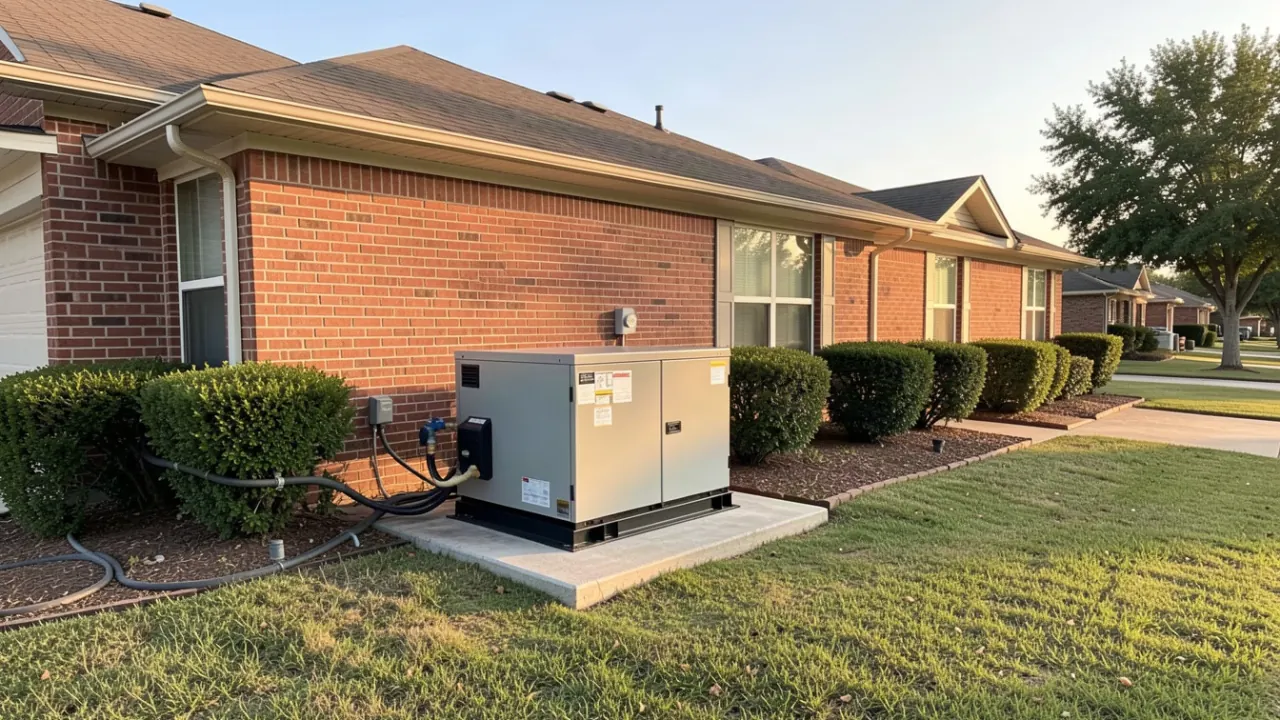
Whole home or essential circuits
Start with the choice that drives everything else.
- Essential circuits keep the basics going: refrigerator, freezer, some lights, the furnace fan, internet and a few outlets. Angi lists partial units of 9 to 20 kW at $2,000 to $6,300.
- Whole home coverage adds central air, the range, the water heater and anything else on the panel. Units of 22 to 48 kW run $5,000 to $18,000 in the same guide.
A middle path is load management. Generac describes pairing a mid-sized unit with a load manager that sheds big loads automatically during peaks, which lowers both purchase and running cost.
The formula pros use
Generac gives this working formula:
Total kW = sum of all running wattages + the highest single starting wattage.
PowerOutage.us takes a simpler route: add running watts, multiply by 1.2 for a buffer, then divide by 1,000 to get kW. Its sample house came to 10,815 running watts, or about 13 kW with the buffer.
Typical appliance loads
| Appliance | Running watts | Starting watts |
|---|---|---|
| Central AC, 3 ton | 3,500 | 7,000 |
| Refrigerator | 700 | 2,200 |
| Gas furnace fan | 800 | 1,600 |
| Sump pump | 800 | 1,300 |
| Electric water heater | 4,000 | 4,000 |
| Lights, 10 fixtures | 1,000 | 1,000 |
Source: PowerOutage.us. Your nameplates may differ. Generac puts a 3-ton central AC at roughly 3.5 to 5 kW running and notes motor starts often pull two to three times the running figure.
A sample Dallas load
Take a single-story house with gas heat, gas water heat and one 3-ton AC. The owner wants the fridge, lights, internet, furnace fan and AC running together.
- Running loads: AC 3,500, refrigerator 700, furnace fan 800, lights 1,000, plus a few hundred watts of outlets. Call it about 6,300 watts.
- Largest start: the AC compressor, which jumps from 3,500 running to about 7,000 starting.
- Generac's formula adds the full 7,000 starting figure to the 6,300 running total, for about 13 kW.
- The PowerOutage.us buffer method gives 6,300 times 1.2, or about 7.6 kW, which leaves little room for that AC start.
The gap between those two answers is the point. A careful pro sizes for the motor start, not just the steady draw. Add an electric range, a second AC or a pool pump and the number climbs fast. That is why the pro walks the panel instead of guessing.
Why square footage misleads
Generac says most 2,000 square foot homes need a 20 or 22 kW unit for whole-home coverage. Angi's chart suggests 10 to 14 kW for the same size house. Both can be right, because one house has gas heat and one AC while another has two AC systems, an electric range and a pool pump. Generac notes two identical floor plans can differ by 8 kW or more.
How a pro sizes your home
- Walk the panel. List each circuit and what it feeds.
- Read nameplates. AC condensers, pumps and water heaters carry their electrical data on the label.
- Pick the coverage. Whole home, essential circuits or load-managed.
- Run the numbers. Running loads plus the largest start, with a margin.
- Match a unit and switch. The generator size and the transfer switch installation plan go into one written quote.
Commercial jobs work the same way at a larger scale. The City of Dallas asks for a load analysis with every non-residential generator permit. Whoever does the calculation and wiring should hold an electrical contractor license, which you can confirm with TDLR.
Cost by size
| Size | Reported cost | Covers |
|---|---|---|
| 7.5 to 10 kW | $2,000 to $3,500 | Essentials plus furnace fan |
| 14 to 18 kW | $4,000 to $5,500 | Essentials plus AC and water heater |
| 20 to 24 kW | $5,000 to $6,500 | Most homes, including multiple AC units |
| 26 to 32 kW | $6,500 to $15,000 | Larger HVAC and several water heaters |
Source: Angi, unit prices. Installation is extra. See generator installation cost and whole home standby generators.
Areas we cover for generator sizing
Generator questions
Is a 22 kW generator enough for a house with two AC units?
Often, if the units do not start at the same moment. Many controllers stagger starts or shed one system briefly. The pro checks both condenser nameplates and your other loads before saying yes.
Does an EV charger change the size I need?
It can. A charger is a large steady load. PowerOutage.us lists EV charging as one factor that raises the size, so tell the pro if you own an electric vehicle or plan to.
What happens if my generator is undersized?
It overloads when too much starts at once. Breakers trip or the unit shuts itself down, and big motors like AC compressors may not start at all.
Can I size a generator from my electric bill?
Not well. A bill shows energy used over a month, not the peak load at one moment. Sizing needs the running and starting watts of what you want on together.